The Chip Insider®– Q&A: Intel's Resurgence. New Chip Concepts.
Inside G. Dan Hutcheson’s latest analysis, Intel surges back to strength, turning geopolitics into partnerships while advancing next-gen compute from GPUs to silicon photonics.
Intel's resurgence
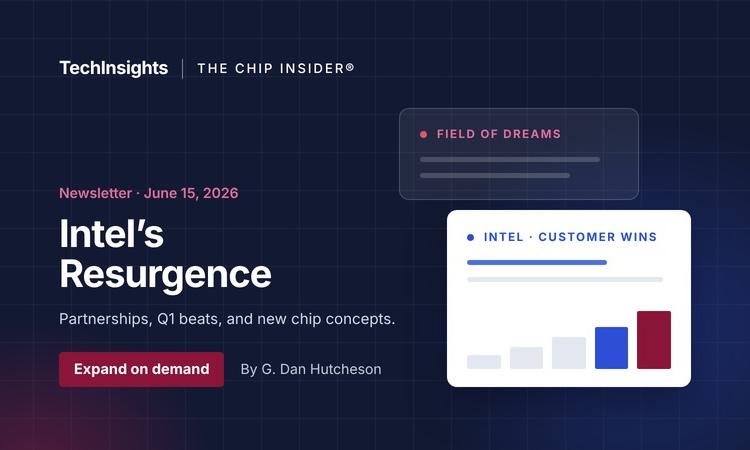
Intel's Resurgence… firing on all cylinders again, while the geopolitics and end markets have shifted in its favor… Lip Bu… shifted the external focus to being customer centric and trust building… shifted the internal focus to operational excellence and financial discipline… Intel's capex strategy from 'field of dreams' to 'expand on demand.' … Investors discovered Lip Bu is an executive whisperer, as he came out of that meeting with the government taking a 10% equity stake in Intel. Then came … SoftBank… Nvidia's Jensen Huang … Google… Elon Musk… TeraFab… Apple… Of course, these customer successes are more than whispering on Lip Bu's part… The same geopolitics… is driving the other companies to partner with Intel: They need a US source of manufacturing, and they need a second source to TSMC. Plus, TSMC is fully booked... As for Q1, Intel pulled 4 aces: beats on revenue, earnings, top-line guide, and bottom-line guide… there's a new to the new-Intel trinity of Lip Bu Tan, Dave Zinsner; and Naga Chandrasekaran. Lip Bu is converting relationships into partnerships and revenue. Dave is healing financial and decision mistakes of the past into profitability. Naga is converting execution at speed into learning and yield…. As for Apple doing business with Intel again with them and Intel’s ability to deliver on that new deal, it's all about… As for having turned things around, semiconductors are the extreme sport of business. Even when you’re in the lead, you’re only one minor slip from being in Death Valley… They have a massive whack-a-mole job. The good news is there is an industry-wide shortage of capacity and Intel is the only one who is not at peak efficiency and has room to grow.
New concepts in chips
New Concepts in Chips… as well as old: The GPU optimization stack, fungible compute, silicon photonics, neuromorphic computing, and Custom-Silicon/ASICs… The GPU optimization stack concept is simply optimizing beyond the GPU. It ranges up and into the compute stack from the GPU through memory… These concepts are essentially an application of DTCO and STCO to GPUs and their associated systems. The first, Design Technology Co-Optimization focuses on optimizing the interaction between the virtual world of design with the real world of process technology. The second, System Technology Co-Optimization, scales this up to the system level… STCO is the newest version of this approach, emerging with Heterogeneous Integration at the chip level, along with power and networking needs in the data center. AI is transforming the entire compute stack with the node. So, STCO is a proactive approach to deal with these. So, the GPU optimization stack concept applies these to the development of entire, GPU-centric, data centers.
Fungible compute: Similar to money, fungible compute is the idea that compute resources should be fully interchangeable… The need for fungible compute has emerged because compute resources have become overly optimized to specific workloads...
Silicon photonics: Silicon photonics adds value to chips by increasing speed, lowering heat dissipation, and lowering power/FLOP. Hence higher prices and margins for chip makers. With SiPho…There is also the so-called ‘copper wall.’ It describes the fact… This is why there has been a long-term trend to replace copper with photonics…
Neuromorphic computing: Neuromorphic computing uses an architecture that mimics the brain with analog circuits, instead of the von Neumann digital ones. Invented in the 80s, it has … IBM continues to work in this space, having developed its TrueNorth and NorthPole chips. So has Intel, with their Loihi series. Like the brain, Neuromorphic computing chips offer the promise of extreme energy efficiency and should also be faster at AI inference… More recently, NPU architectures have been introduced as chips from companies like BrainChip, Innatera, and Prophesee… Instead of emulating the brain’s…
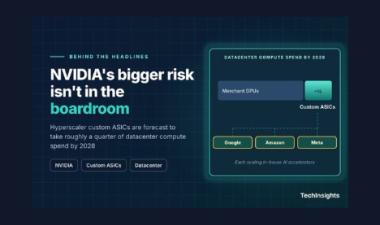
Custom-Silicon/ASICs: Custom-Silicon/ASICs are one in the same and simply chips designed to optimize specific workloads... The hyperscaler make-or-buy decision is based on the efficiency gained, times the workload size. They make their own chips when the gain more than offsets the cost of a custom design. They manage design cost by lagging a node or two behind, which is another factor in the calculation, as is compute fungibility.
Further reading: I highly recommend watching Grace Hopper’s masterful lecture on the future of computing that envisions all this and the problems we face today way back in 1982: Watch Grace Hopper’s 1982 lecture. After watching, you’ll understand why Nvidia honored her by naming an entire generation of chip technology after her.
About The Chip Insider®
Gain a competitive edge with The Chip Insider®, the trusted source for strategic and tactical insights tailored for senior semiconductor executives. Stay ahead with edgy, blunt industry analysis, exclusive email reports, and expert perspectives on market trends, strategies, and key challenges.

Vice Chair, Senior Research Fellow
Dan is Vice Chair of TechInsights Inc. He is a recognized authority on the semiconductor industry, winning SEMI’s Sales and Marketing Excellence Award in 2012 for “empowering executives with tremendous strategic and tactical marketing value” through his e-letter, The Chip Insider®; his book Maxims of Hi-Tech, and his many interviews of executives.
At a glance
- Series
- The Chip Insider®
- Author
- G. Dan Hutcheson
- Intel focus
- Customer partnerships and manufacturing growth
- Compute concepts
- GPU optimization, fungible compute, and ASICs
- Emerging technologies
- Silicon photonics and neuromorphic computing
Never miss an edition
Strategic and timely insights tailored for senior semiconductor executives.
Access the latest editionStrategic and tactical insights tailored for senior semiconductor executives.
Access the latest Chip Insider® edition. Sign in or create a free TechInsights Platform account.