Chip Observer:November 2026
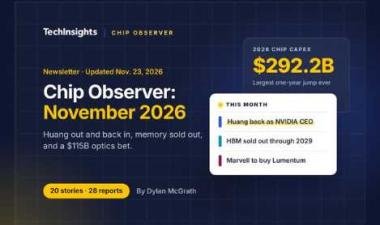
The November 2026 edition of Chip Observer covers major industry news and developments, including Jensen Huang's resignation, the deepening memory shortage, and Marvell's $115 billion acquisition of Lumentum.

Industry Observatory
NVIDIA in the Crosshairs6
The Memory Crunch Deepens4
Mergers, Acquisitions, and Funding Rounds5
Lost and Foundry5
Under the Microscope
Nvidia in the Crosshairs
6 storiesHuang out, then back in
Updated Nov. 23, 2026: This story was revised after NVIDIA's board reinstated Jensen Huang as CEO on Nov. 23. The original version, published Nov. 20, reported his Nov. 12 resignation under the headline "Huang exits NVIDIA after 33 years."
NVIDIA's board unanimously reinstated Jensen Huang as president, CEO and board director on Nov. 23, 11 days after he resigned. Huang stepped down on Nov. 12, four days after he admitted to an affair, amid reports linking him to a former Megaspeed CEO alleged to work for Chinese intelligence.
The board said it was satisfied with Huang's "candor and ability to lead NVIDIA." It said it had "received input from senior levels of the United States government" and is confident his return "poses no national security risk," but did not name the officials. President Trump told CNBC he had urged the board "directly and indirectly" to bring Huang back: "I convinced them."
Colette Kress, who served as interim CEO, returns to her role as CFO, and Harvey Jones remains chair. An independent board investigation into reports that Huang was the target of a foreign intelligence effort "will proceed to conclusion." The board also formed a National Security and Export Control Committee of independent directors and is hiring a chief compliance officer.
The reversal drew criticism from both parties in Congress. Huang is due to testify publicly before the Senate Banking Committee on Dec. 3 and to sit for interviews with three House committees. For what the episode means for the AI industry, see this month's Editorial.
Washington digs into chip diversion
Updated Nov. 23: After NVIDIA reinstated Huang, Senate Banking Committee Chairman Tim Scott said Huang will testify publicly on Dec. 3.
Senators asked that records related to chip exports and Megaspeed be preserved and called for tighter AI-chip export controls, and House committee leaders requested a closed-door briefing from Huang on November 18. Axios reported that President Trump authorized tougher action against suspected NVIDIA chip diversion three times this year, but Commerce Secretary Howard Lutnick resisted due to concerns about escalating trade tensions with China. NVIDIA’s general counsel had reportedly contacted a senior Commerce official about the Megaspeed chip-smuggling investigation in late summer 2025.
600,000 H200s wait in Hong Kong
About 600,000 NVIDIA H200 chips are reportedly being held in Hong Kong while they await Beijing’s import approval, according to Reuters. Beijing is limiting imports to reduce its reliance on US technology. Chinese firms had reportedly ordered more than 2 million H200s, worth about $54 billion, after the US approved exports in December 2025.
HBM leaks into China as Oracle drops Tencent
Samsung and SK hynix HBM is reportedly reaching Chinese AI chip developers, including Huawei customers, through smuggling that exploits export-control loopholes, according to The Information. Intermediaries reportedly pair the HBM with low-end server processors, ship the systems to China, and then remove the memory for resale.
Separately, the Financial Times reported that Oracle canceled a five-year deal, worth an estimated $7 billion, that would have given Tencent access to up to 100,000 advanced AI chips in Southeast Asian datacenters. The cancellation followed pressure from the Trump administration, and Guangdong officials have urged Tencent to use domestic chips.
TechInsights analysis
ReportTechnical Briefing: 2026 High Performance Computing Analyst Briefing 1NVIDIA’s $124 billion web of stakes under scrutiny
The Financial Times says NVIDIA made more than 120 investments this year and held or committed about $124 billion in equity investments by July, many of them in companies that buy its chips. Huang's brief exit raised questions about whether that deal-making would continue; his Nov. 23 return settles who leads NVIDIA, but not the scrutiny of the stakes. NVIDIA and AMD also took stakes in Meta in October as Meta expanded its use of both companies’ AI infrastructure.
TechInsights analysis
AnalysisNarrative: Datacenter/Cloud Q2 2026 – Backlogs Swell, Cash Flow ShrinksTPUs and custom silicon gain ground
Google added two 8th-generation TPU systems: TPU 8i Max, for very large context windows and higher rack compute density, and TPU 8tx, for secure and confidential inference, which pairs Google’s accelerators with AMD EPYC host CPUs. OpenAI reportedly plans to buy Google TPUs, and Oracle will offer TPUs through its cloud starting in 2027. Broadcom XPUs and networking will also support Anthropic’s AI infrastructure from 2027, under a $63 billion financing arrangement.
The Memory Crunch Deepens
4 storiesSold out through the decade
SK hynix expects memory supply constraints to last through 2030, with DRAM and HBM effectively sold out through 2029. Samsung expects tight supply through 2028 and says its 2027 HBM is already sold out, citing long fab construction and tool lead times, larger dies, more complex next-generation HBM, and DRAM capacity shifting to HBM. Anthropic’s IPO filing also warns that HBM shortages and limited TSMC capacity could constrain AI expansion.
Memory makers post record quarters
SK hynix reported record quarterly revenue of about $78 billion, up 328% year over year, and Samsung reported about $146 billion, up 127%, driven by its HBM4 ramp. The boom is reaching the rest of the supply chain: Advantest revenue rose 82% and Teradyne’s rose 70% on record memory test demand, and Applied Materials’ fiscal Q4 revenue rose 53%.
TechInsights analysis
ReportTechInsights Outlook 2027: Five Trends Reshaping the MarketNew memory capacity, mostly years away
Samsung broke ground on its HBM advanced-packaging facility in Asan, South Korea, and moved the planned start of production up a year to June 2028. SK hynix’s US unit Solidigm is reportedly discussing a proposed $45 billion NAND flash fab with the US Commerce Department, and Winbond approved NT$73.1 billion (US$2.2 billion) to expand its 300mm memory fab in Kaohsiung, Taiwan.
TSMC is reportedly considering 3D DRAM production at NVIDIA’s request, though it says it remains focused on logic. Micron, meanwhile, has reportedly paused construction of a $4.5 billion memory plant in Taiwan over a labor dispute, according to Bloomberg; Micron has not confirmed the report.
TechInsights analysis
Report300mm WatchCXMT pushes into HBM
China’s CXMT plans limited HBM3E production soon, despite yields of only 20–30%, according to Reuters. Together with reports of HBM smuggling, the move shows how hard China is pushing for HBM supply while Samsung, SK hynix, and Micron remain sold out.
TechInsights analysis
ReportTechnical Briefing: 2026 High Performance Computing Analyst Briefing 1Mergers, Acquisitions, and Funding Rounds
5 storiesMarvell bets $115 billion on light
Marvell agreed to acquire Lumentum in an all-stock deal with an implied enterprise value of $115 billion, combining Marvell’s custom silicon and networking with Lumentum’s lasers, transceivers, and optical circuit switching. The deal is expected to close in the first half of 2028, subject to shareholder and regulatory approval.
Analyst views are mixed. Supporters see a chance for Marvell to challenge Broadcom in AI optics, while critics raise concerns about the price, regulatory approval, and the concentration of laser supply in one company.
Mitsui Chemicals lands JSR
Mitsui Chemicals confirmed it will acquire JSR in a deal valued at about $11.9 billion, combining two major Japanese materials suppliers. The deal includes JSR’s photoresist and advanced materials businesses.
TSMC buys into its biggest end customers
TSMC approved investments of up to $1 billion in OpenAI and Anthropic, allocating up to $500 million to each, plus a separate $500 million investment company focused on the semiconductor ecosystem.
TechInsights analysis
ReportMcClean Report May 2026: Foundry Market Overview and ForecastDeals for power, debug, edge AI, and quantum
onsemi will acquire Ferric, a developer of integrated voltage regulators, for $600 million in cash plus up to $175 million in milestone payments. Siemens plans to acquire Lauterbach, a provider of hardware-assisted debugging and trace tools for embedded software and complex SoCs, with the deal expected to close in the first half of 2027. Analog Devices completed its acquisition of Alif Semiconductor on November 3, and Intel plans to acquire Classiq to add a quantum software stack to its spin-qubit work.
TechInsights analysis
AnalysisInsight: Analog Devices, Billion AI Minds, in the Beginning was AlifAI chip startups raise big
Fractile raised $720 million to develop AI chips that stack DRAM directly on top of logic to speed up output token generation. FuriosaAI raised $620 million in a Series D round to scale production of its AI inference accelerator.
Lost and Foundry
5 storiesPackaging pricing power
TSMC is reportedly considering a 20% CoWoS price increase while skipping its usual equipment price renegotiations. ASE forecasts its advanced-packaging revenue will double in 2027, and Amkor is ramping new high-density fan-out and 2.5D programs. Applied Materials plans to raise its stake in Besi to about 20%, expanding its partnership beyond hybrid bonding, and UMC approved an additional $3.2 billion in capital spending for advanced packaging and silicon photonics.
Intel Foundry shows progress
Intel reported Q3 revenue of $16.5 billion, up 21% year over year, with datacenter and AI sales up 78% and foundry revenue up 58%. Intel says 18A yields and cycle times are improving. It released the 14A 0.9 PDK in October and is in talks with external customers about 18A-P and 14A.
Samsung’s next 2nm moves
Samsung reportedly plans a new foundry in Giheung, South Korea, with 2nm and 4nm lines and possibly advanced packaging, at an estimated cost of about $17 billion. It has also reportedly won orders from AMD and NVIDIA for 2nm HBM base dies at a proposed second fab in Taylor, Texas, targeting mass production in 2030. Samsung has confirmed neither report.
TechInsights analysis
Report300mm WatchPower semiconductors move to 300mm
Infineon fabricated functional power devices on 300mm silicon carbide wafers at its Villach, Austria fab using existing silicon processing equipment. The larger wafers hold 2.3 times as many chips as 200mm wafers. Infineon also plans to invest €1.1 billion through 2034 in 300mm GaN production at Villach.
Elsewhere, onsemi canceled a SiC manufacturing expansion in the Czech Republic, and Bosch plans a dedicated semiconductor division in January 2028, targeting €5 billion in semiconductor sales by 2030.
TechInsights analysis
ReportNarrative: Power Semiconductor Market Share Q2 2026UCIe 4.0 takes chiplets to the system level
The UCIe Consortium published UCIe 4.0, which extends the specification from chiplet-level interfaces to the integration of multiple chiplets into an on-package system. New features include an on-package memory link and improved energy efficiency, manageability, security, and reliability. Separately, imec completed baseline process flows for its NanoIC silicon-interposer platform, with a PDK planned for early 2027, and ASRA and imec released requirements for interoperable automotive chiplets.
TechInsights analysis
ReportRoadmap: Advanced Packaging Technology and Market Analysis ReportAI Party Crashers: How Jensen Huang’s Scandal Could Sober Up the Chip Boom
Editor's note, Nov. 23, 2026: This editorial was updated after NVIDIA's board reinstated Jensen Huang as CEO on Nov. 23. Its argument is unchanged. Passages that treated his departure as final have been revised, and a section on the reinstatement has been added.
Rarely do we at TechInsights feel compelled to comment on what would ordinarily be a private family matter, such as Jensen Huang’s extramarital affairs. But we can’t think of a time when one executive’s personal failing could have such far-reaching implications for the semiconductor industry, not to mention the broader AI infrastructure ecosystem, US national security, and the entire global economy.
Following revelations of multiple affairs, including with subordinates at NVIDIA, Huang stepped down from his post as CEO on November 12, in what seemed like a sad end to a remarkable run. Whatever his personal failings, it is undeniable that Huang is a visionary and skilled executive who co-founded NVIDIA and spearheaded its rise from a niche PC graphics card vendor to a global AI accelerator powerhouse, turning it into the most valuable and arguably the most important company in the world.
It's still too early to know how the chips will fall for the broader semiconductor industry. We will likely never know the full extent to which Huang’s relationship with an alleged Chinese intelligence asset—one linked to a firm suspected of diverting restricted chips—altered the playing field in the US–China AI race. It may prove monumental, or it may amount to little or nothing at all.
What is far easier to predict is the impact on US domestic and foreign policy. This scandal breaks on the heels of a midterm election in which voters made their skepticism toward the frantic AI infrastructure build-out unmistakable. Across 47 decided local ballot measures concerning datacenters this year, voters sided against unchecked expansion in 46 of them—approving bans and moratoriums while rejecting pro-development initiatives.
AI already had a severe public-relations problem. Over the past year, public perception has shifted from viewing AI as a technological marvel to fearing a resource-hungry force that strains local water and power grids, threatens mass unemployment, and—according to warnings from prominent AI insiders themselves—poses existential risks to humanity.
Layer onto that a growing populist backlash against the concentration of economic, defense, and policy influence in the hands of a few unelected tech titans—a dynamic underscored when prominent tech leaders and even the White House publicly campaigned to bring Huang back. Huang has spent the past year lobbying Washington for lighter AI regulation and looser export controls to China. Now, with public testimony before the Senate Banking Committee on Dec. 3 and House interviews to follow, his credibility in Washington —and that of the broader industry—has taken a direct hit.
Then the board brought him back. Eleven days after Huang resigned, Nvidia's directors voted unanimously to reinstate him, citing "input from senior levels of the United States government" that his return "poses no national security risk." They did not say who gave that input. President Trump did: "I convinced them," he told CNBC.
For voters already uneasy about AI, the sequence is hard to miss. An executive at the center of an espionage-linked inquiry stepped down, then returned after a word from Washington, while the board's own investigation was still under way. Whatever that investigation finds, the reversal is a plain illustration of what many people already suspect: the rules bend for the people at the top of the AI economy. If Huang's resignation suggested that even AI's most powerful figure answers to someone, his reinstatement suggests the opposite.
The backlash crossed party lines. "No national security risk? Based on what?" asked Sen. John Cornyn (R-Texas). Sen. Ron Wyden (D-Ore.) said "our national security is for sale." With Huang due to testify publicly on Dec. 3 and Democrats taking committee gavels in January, the story will stay in front of voters well into 2027.
Calls for tighter regulation and oversight from voters and their elected representatives will only grow louder, and the reinstatement hands them their sharpest argument yet. While greater scrutiny may well be warranted, given the reasons mentioned above, the resulting friction from stricter export enforcement and slower datacenter permitting will act as a serious drag on a semiconductor sector in the midst of a historic boom. It won’t shut down the AI party, but regulators and local voters are about to turn down the music.
Data Observatory
Record memory revenues driven by insatiable AI-related demand, constrained supply, and sky-high ASPs continue to account for both the new highs the semiconductor industry is reaching and a large share of investment in manufacturing capacity. Memory sales are projected to account for 58% of all IC industry revenue in 2026, up from 30% in 2025, despite their share of total chip production actually declining very slightly. Memory ASPs are projected to grow a whopping 214% YoY in 2026, with further increases expected in 2027.
Despite increases in capacity and utilization, sales continue to outpace both current and future anticipated production, lengthening delivery timelines and continuing to drive inventory-to-booking ratios down to record low levels. This trend is almost entirely driven by memory, as non-memory I:B ratios have stabilized in recent months. Only continually rising ASPs have kept the value of inventory on hand stable.
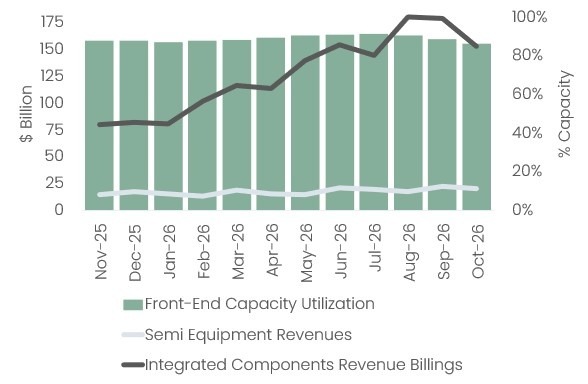
Despite substantial ongoing capacity additions, utilization rates remain near historic highs as AI-related demand eats up additional production as soon as it comes online (Figure 2). Companies across the supply chain continue to add capacity and ramp up utilization.
 Enlarge
Device Observatory
In October, the Microprocessor Report team focused its product analysis on a broad range of computing markets, with reports covering Qualcomm's Dragonfly C1000 server processor, NXP's S32N7 automotive processor, Qualcomm's Dragonwing Q-2390 IoT processor, and Ambiq's Apollo510 Lite and Apollo330 Plus ultra-low-power edge processors. Our Quick Takes coverage examined Huawei's Kirin 9050 Pro and Microsoft's Maia 300 AI accelerator. We also covered OCP Global Summit 2026, highlighting developments across the open computing ecosystem. We tracked 159 device launches and two new IP introductions this past month.
To view the full list, read Microprocessor Report October 2026 Review.
Full Reports
Market Observatory
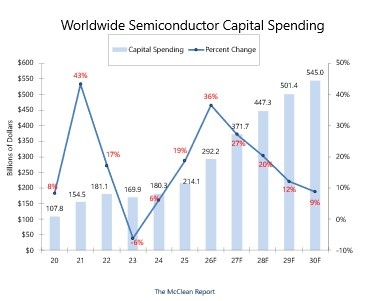
Chipmakers’ capital spending is on its own historic run. TechInsights has raised its 2026 semiconductor capital expenditure forecast to $292.2 billion, about 36% more than the $214.1 billion spent in 2025. That is the largest one-year jump on record. Companies are paying to build new fabs and to upgrade existing ones for advanced-node production. AI accelerators, networking chips and HBM remain the top priorities, but spending is also rising on high-capacity NAND flash and on advanced packaging and test equipment.
Advanced logic and foundry make up nearly half of 2026 spending, at about $138.5 billion. DRAM is the next-largest category at roughly $90.7 billion, driven by HBM demand. NAND accounts for about $32.2 billion. Spending on discretes, analog and other devices, at around $30.8 billion, is expected to dip slightly as automotive and industrial customers work through excess inventory. TSMC is the largest single spender at an estimated $62.7 billion, much of it for 2nm capacity. Samsung ($39.8 billion), SK hynix ($33.1 billion), Micron ($29.6 billion) and Intel ($21.2 billion) round out the top five. Companies based in South Korea and Taiwan account for about half of all capex, at roughly $73 billion each.
TechInsights expects heavy spending to continue. It forecasts capex of about $372 billion in 2027, up 27%, and about $447 billion in 2028. Spending is expected to reach $545 billion by 2030, as heavy hyperscaler investment in AI infrastructure flows down to chipmakers. Tariffs and geopolitical tensions could make some companies more cautious in the near term, but AI demand remains the main long-term driver.
Recent news fits the forecast. Samsung is reportedly planning a roughly $17 billion 2nm and 4nm fab in Giheung, and UMC approved another $3.2 billion for advanced packaging and silicon photonics. Winbond committed $2.2 billion to expand its memory fab in Kaohsiung, and Solidigm is reportedly discussing a $45 billion NAND fab in the US. Equipment makers are benefiting too: Applied Materials’ fiscal Q4 revenue rose 53%, and Advantest’s revenue rose 82% on AI tester demand.
 Enlarge
Interesting Observations
The Most Thought-Provoking Recent TechInsights Reports
Marvell and Lumentum - Buying the Light Source Before CPO Scales
Marvell is paying a premium for something scarce. This report examines Marvell’s $115 billion all-stock acquisition of Lumentum, which brings a supply of lasers and optical circuit switches to a leading DSP and custom-silicon vendor just as co-packaged optics (CPO) moves from pilot to volume. TechInsights forecasts that optical interconnect for AI datacenters will grow to eight times its 2025 revenue by 2030, with CPO supplying two-thirds of market growth in 2028. The report also weighs the risks from the price, the regulatory path, and competitors’ responses.
Read in the PlatformThe Chip Insider – Variability’s role in fab strategies, tactics, and die yield
The most important variable in running a chip company is rarely discussed outside closed rooms, and it isn’t wafer cost, nodes, or even yields. This report argues that revenue per wafer is what matters most. It examines how chipmakers balance revenue per wafer against cost per wafer, and how process control, which has cut variability 113-fold over six decades, shapes fab strategies, tactics, and die yields.
Read in the PlatformApple A20 Pro SoC (TSMC N2) WMCM Advanced Packaging Analysis
The A20 Pro marks Apple’s biggest packaging change since it adopted TSMC’s InFO with the A10. This report documents how Apple replaced the InFO package-on-package architecture used from the A10 through the A19 with a wafer-level multi-chip module (WMCM) that places the processor and DRAM side by side on a common fanout redistribution layer. The shift changes Apple’s memory integration strategy, package routing, and thermal design.
Read in the PlatformManufacturing Outlook 2027: Five Trends Reshaping the Market
Memory will account for 62% of a $2.6 trillion semiconductor market in 2027, and it will also be the industry’s tightest constraint. This outlook breaks down the five trends behind that shift, from HBM pulling capacity away from conventional DRAM and NAND to bottlenecks spreading into advanced packaging and mature nodes. It names who gains in 2027, including HBM-capable memory makers, TSMC, and etch, deposition, and bonding toolmakers, and who is most exposed.
Read in the PlatformA Packaging Perspective on Photonics and CPO
AI clusters are pulling optical engines out of front-panel pluggable modules and onto the switch package. This review examines what AI datacenters demand from optics, how those demands land on the package, and where silicon photonics goes next. Co-packaged optics moved into production in 2026 with NVIDIA’s and Broadcom’s first CPO switches, while Huawei backed a near-packaged alternative.
Read in the PlatformRetro Tech
 Enlarge
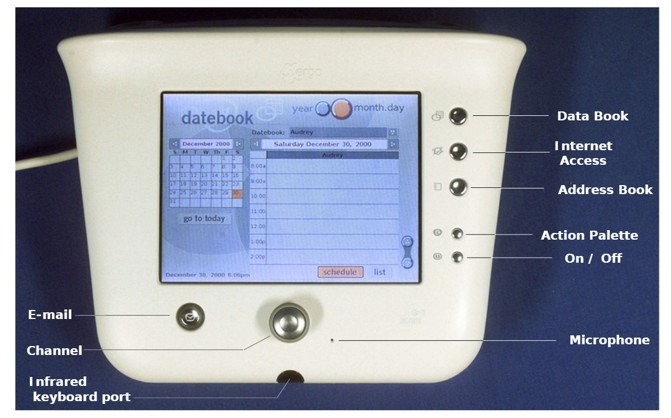
The 3Com Ergo Audrey was an internet appliance released in October 2000, intended as the first entry in a product family for “ubiquitous computing,” with Audrey designed for use in the kitchen. Powered by a 200 MHz x86-compatible National Semiconductor Geode GX1 processor with 32 MB of RAM and 16 MB of NAND Flash, the system also included a 7.8-inch STN touchscreen and an infrared wireless keyboard.
The Audrey used a 56k V.90 dial-up modem to connect to the internet to sync with an information service to retrieve mail and news headlines. It included a second RJ11 port, allowing the device to sit between the wall phone jack and a landline phone. The system software was a customized version of National Semiconductor’s Web-PAD interface, running atop QNX, and supported Palm’s HotSync technology, allowing Palm Pilot users to sync with the unit using a RS-232 serial cable.
Internet appliances were considered an emerging market in 2000. Competing devices were often bundled with specific ISP contracts to subsidize hardware costs, but the Audrey was ISP-independent, allowing it to work with standard dial-up providers. 3Com sold the Audrey for $499 (with an estimated bill of materials and assembly cost of $331.99). However, after incurring heavy losses, 3Com exited the internet appliance business in March 2001, failing to find a buyer for the product line.
The Audrey—and other internet appliances—are something of a forerunner to Amazon’s Echo Show or Google’s Nest Hub smart home assistants, which arrived on the market over 15 years after the Audrey was discontinued. Some similarities between the Audrey and Apple’s new HomeView product are evident—both are wired 7-inch displays intended for family sharing in the kitchen, though the HomeView draws on Apple’s iMac G4 and 25 years of hardware development.
The first—and only—device in the Ergo series was named for British actress Audrey Hebpurn, though the development codename was “Kojak”, named for the Telly Savalas character and series of the same name. (There is a substantial visual difference between the two people.) 3Com planned a follow-up living-room PC for the Ergo product family, which was given the codename “Mannix,” though it was never released.