Market forecasts predict an optimistic future for the Internet of Things (IoT) market; Forbes predicts that it will double to $520B in 2021, and other sources estimate the market will be as high as $6.5 Trillion by 2024. By 2020, there will be 8 billion connected objects in the world, and IoT devices are transforming the way we live whilst creating tremendous opportunities for everyone from established hi-tech juggernauts to start-up entrepreneurs.
The explosive growth of the Internet of Things (IoT) is leading virtually every industry incorporating connected technologies to ensure it’s ready to move toward an automated society. Everything is becoming connected and interactive, and more data about us is transmitted across networks and saved in the cloud, as our daily lives continue to evolve alongside technology including homes, cars, wearables, healthcare devices, cities, and utilities.
IoT is arguably the strongest semiconductor industry driver since the emergence of the smartphone in 2007, with annual growth of the number of “things” increasing by 25% every year since 2013. Network requirements of the IoT demand communication technologies that offer long-range connectivity, low power consumption, and affordable expansion; and, in that, distinct trends have begun to emerge in IoT device design.
Early IoT products were built using multiple chips to solve for computing, memory, and transmission functions, and now we see the emergence of System on Chips (SoCs) employed by companies like Nordic, MediaTek, Dialog, STMicroelectronics, Qualcomm, etc. Combining multiple systems on a single chip gives the manufacturers a greater ability to control component interactions and allows IoT products to become smaller and more efficient.
TechInsights has been publishing technology analysis for over 30 years, enabling our customers to advance their intellectual property and product strategies.TechInsights completes a wide variety of in-depth teardowns on IoT devices each year, including smart speakers, drones, security cameras, thermostats, lighting etc. We provide insight into design wins, bill of materials, block diagrams, and IC analysis that spans detailed die-level structural, process, and circuit information.
If you are a technology professional interested in IoT teardowns and/or IC analysis, you may want to learn more about: Teardown IoT Home and IoT Connectivity SoC subscriptions.



If you are an IP Professional, you may be interested to learn more about a subscription to TechInsights Library. A successful IP strategy in this field requires an awareness of disruptive events in IoT of economic significance, knowledge of key and upcoming market players, and the correct application of reverse engineering techniques to identify the changes from generation to generation of the latest IoT technology.

Apple iPhone 18 Memory Costs: DRAM & NAND Price Pressure
DRAM and NAND prices are rising through the iPhone 18 launch. See what higher memory costs could mean for Apple, AI, BOM costs, and smartphone strategy.

Apple iPhone 18 Pro: A20 Pro, Camera, C2 Modem & Key Changes
Explore what is new in the Apple iPhone 18 Pro and Pro Max, including the 2 nm A20 Pro, variable-aperture camera, C2 modem, cooling, and battery.
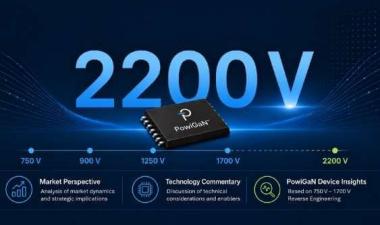
Can 2200 V PowiGaN Challenge Silicon Carbide?
Access TechInsights’ special report on Power Integrations’ 2200 V PowiGaN demonstration and its potential impact on high-voltage power semiconductor markets.

The Authoritative Information Platform to the Semiconductor Industry.